Manual Tire Deflator vs CTIS.
The two camps.
Every UAE 4×4 owner ends up in one of two camps. The first carries a deflator in the glove box, kneels at the edge of the dunes for 25 minutes every trip, and accepts the routine. The second installs a permanent system and never thinks about tire pressure mechanics again.
This article isn't a pitch for one side. It's an honest comparison of the trade-offs by use case — because both options are valid depending on how often you actually drive in the desert and what your tolerance for the kneeling routine is.
Manual deflator — the established option.
The market has three rough categories:
Screw-type / basic deflators (AED 80–150)
You unscrew the valve cap, screw on a small adapter, and let air out. Cross-check with a separate gauge or your TPMS. Cheap, reliable, but slow — one tire at a time, no preset, gauge accuracy varies.
Preset rapid deflators (AED 250–500)
Brands like Staun (Australian, preset PSI cartridge) or TIROX-style. You set the target PSI once with a calibration tool, then on each trip you screw the deflator onto a valve and it auto-stops at target. Faster than basic, more accurate.
Gauge-equipped deflators (AED 300–500)
Combination tools with built-in gauge and bleed valve. You see live PSI while you work. Precise but still one tire at a time.
Plus: a 12V compressor for re-inflation (AED 200–800)
Manual deflation is only half the trip. For re-inflation on the way home, you need a portable 12V compressor — basic ones take 6–8 minutes per tire, premium twin-piston units run 3–4 minutes per tire.
Total upfront cost: roughly AED 400–1,300 for a complete manual setup.
Time per trip: 25–35 min deflation + 25–35 min re-inflation = 50–70 min of tire work.
CTIS — the permanent install.
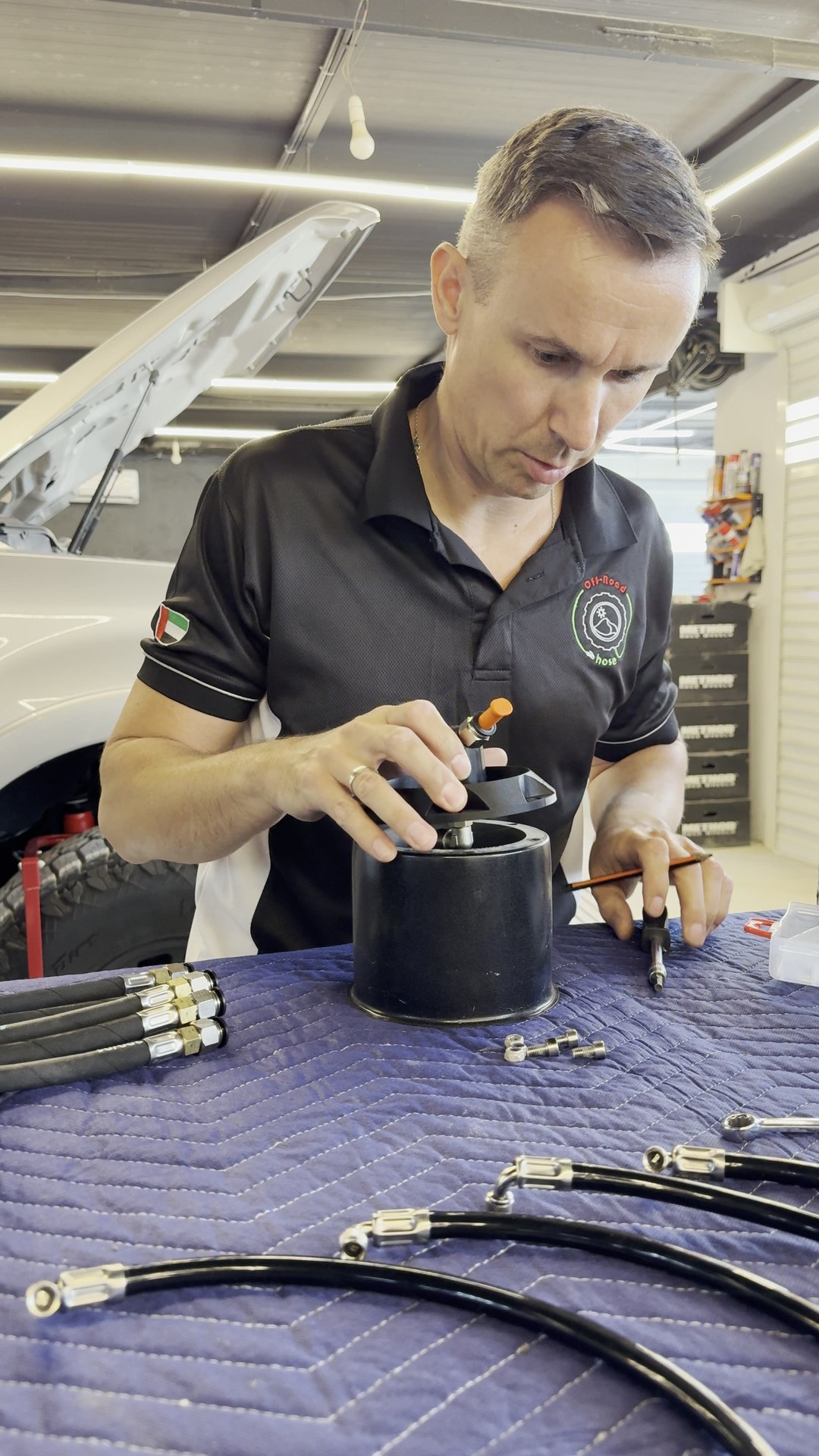
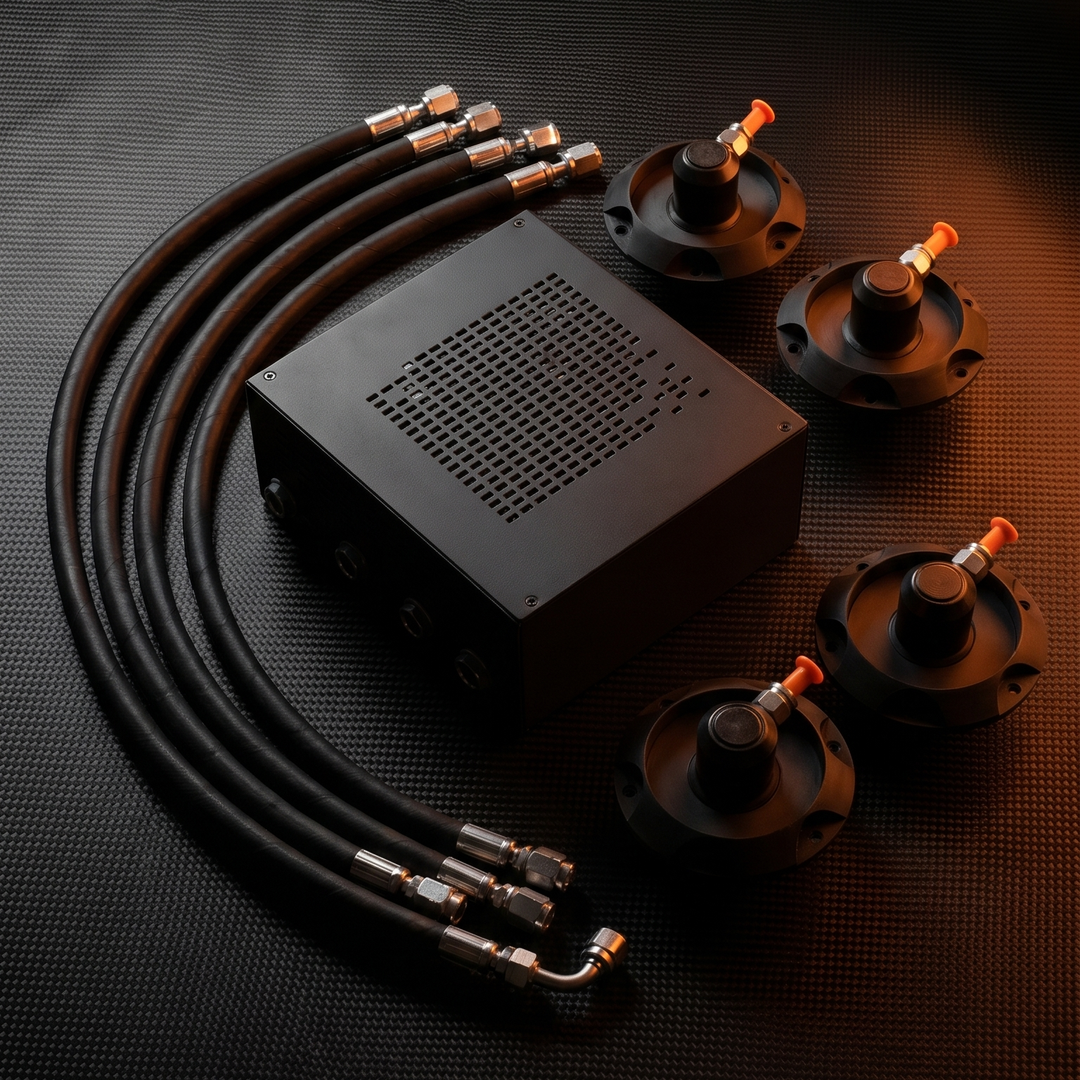
A Central Tire Inflation System is hardwired into your vehicle. Four replacement valve cores, pneumatic hose secured along the underbody with bulkhead fittings at each fender, a control unit mounted in the cab, an app on your phone.
One install, one time, AED ~12,000 in the UAE. After that, every trip is two taps in the app — deflation going in, inflation coming out, all four tires in parallel, from the cab with AC running.
(If you want the full mechanical breakdown, see What is CTIS? Central Tire Inflation System Explained.)
Total upfront cost: ~AED 12,000 with TireCommand UAE.
Time per trip: 2 taps to start each cycle, system runs for a few minutes while you stay in the cab.
Side-by-side comparison.
| Factor | Manual Deflator | CTIS Install |
|---|---|---|
| Upfront cost | AED 400–1,300 | AED ~12,000 |
| Time per trip | 50–70 min total | 2 taps, system runs hands-free |
| Heat exposure | ~1 hr in 45°C | None — stay in AC |
| Precision | ±1–3 PSI typical | ±0.5 PSI digital |
| All-four simultaneously | No — one at a time | Yes — parallel |
| Re-inflation | Separate 12V compressor | Uses your onboard compressor * |
| Maintenance | Replace every few years | 2-yr warranty (TireCommand) |
| Failure mode | Lost or broken in dunes | Onboard fault (rare) |
| Best for | Occasional drivers | Regular dune-bashers |
* Compressor not included with CTIS install. CTIS uses the 12V onboard air compressor already installed in your vehicle. Most serious UAE 4×4 owners already run one for off-road use — if you don't, install it before booking a CTIS.
The math by trip frequency.
The deciding factor for most UAE owners isn't the upfront cost — it's how many trips per year you actually do.
2–5 trips per year (occasional)
Manual deflator wins. A 50–70 minute tire routine 5 times a year totals about 4–6 hours annually. That's tolerable. The AED 12,000 CTIS install would take 5+ years to "pay back" in time savings, and you don't run frequently enough for the heat exposure to be punishing.
10–20 trips per year (regular)
It depends on your tolerance. 10 hours/year of tire work is meaningful but not catastrophic. Heat exposure during UAE summer trips starts to matter. Some owners install CTIS at this frequency; others stick with manual.
30+ trips per year (active dune-basher)
CTIS wins decisively. You're looking at 25–35 hours per year of manual tire work — three full working days of kneeling next to a 4×4 in the heat. The CTIS install pays back in time within the first season, and the physical comfort difference is significant.
The hidden factor: trip compression.
Numbers above assume you actually deflate. Many UAE owners with manual deflators end up skipping deflation on shorter trips ("just a quick run, I'll be fine at 22 PSI") — and either getting stuck or beating up their drivetrain trying to bull through soft sand at the wrong pressure.
CTIS removes the friction that makes drivers skip deflation. When it's two taps, you always run the right PSI. That alone reduces stuck-recoveries, tire damage, and convoy delays in ways that don't show up in a simple cost comparison.
Failure modes — be honest.
Both systems can fail. The realistic failure modes:
Manual deflator failures
- Gauge drifts out of calibration → you inflate to wrong PSI without knowing
- Loses preset over time → next trip you're at the wrong target
- Cheap valve seat fails → can't get a seal on the tire valve
- Lost or dropped in the sand → trip is suddenly harder
- 12V compressor overheats during long re-inflation cycles → stalls
CTIS failures
- Hose leak (rare with proper underbody routing and bulkhead fittings)
- Compressor fault (covered under warranty)
- Software glitch on the app → fallback is the cab-mounted manual control
- Battery drain on extreme convoy days (alternator usually keeps up)
The honest answer is that both can fail in ways that affect your trip. The recommendation regardless of which you choose: keep a basic manual deflator in your glove box as backup. Costs AED 80, takes no space, and ensures you're never stranded.
When manual still makes sense.
- You drive in the desert occasionally (5 or fewer trips per year)
- You have a backup vehicle / aren't relying on your truck as your main 4×4
- You enjoy the mechanical ritual — some drivers genuinely don't mind the kneeling routine
- Budget is tight and AED 12,000 is meaningful right now
- You're driving a borrowed truck or one you'll sell within a year
When CTIS is the right call.
- You run 10+ desert trips per year
- You're routinely deflating in 40°C+ summer conditions
- Your truck is your long-term build — you'll keep it 3+ years
- You're already investing in serious mods (suspension, armor, snorkel) — CTIS is the highest-friction-reduction mod you can add
- You're tired of the kneeling routine, full stop
Bottom line.
Manual deflators work. People have been off-roading with them for decades. If you drive in the desert a few times a year, save your money and buy a good preset deflator + a quality 12V compressor.
If you're an active UAE off-roader — multiple trips per month, summer included — CTIS is the upgrade that finally fixes the kneeling routine. The math works at trip frequency 10+, and the physical comfort difference in 45°C is hard to oversell.
TireCommand is the UAE-installed version: 11,999 AED flat install, every vehicle. Includes parts, full labour, 2-year warranty on both. UAE-wide service, install bay base in Dubai. Compatible with Land Cruiser, Patrol, Wrangler, G-Wagon, Defender, Ford Tremor, Super Duty, and most other 4×4 platforms.

Free walkthrough — same vehicle, real installer.
DM us your specific 4×4 model and we'll send you the full install breakdown: where the controller mounts, hose routing path, app demo, and the install timing. No pressure, no quote chase — just honest information.
DM 'DEMO' on Instagram →Frequently asked questions.
Is CTIS worth it over a manual deflator?
Depends on trip frequency and climate. For UAE owners running 2+ desert trips per month in 40°C+ heat, CTIS pays back in time and physical comfort within the first season. For occasional desert drivers (a few trips a year), a quality manual deflator is fine.
How long does manual deflation actually take?
Realistically 20–30 minutes per deflation cycle on a 4×4 with four tires. Add another 25–35 minutes for re-inflation on the way home using a 12V compressor. Total tire-time per trip: roughly an hour, much of it kneeling in 45°C heat during UAE summer.
How long does CTIS deflation take?
The system takes a few minutes to fully change all four tires from highway PSI to soft-sand PSI. The win isn't raw speed — it's that the driver does nothing during that time. You stay in the air-conditioned cab while the system runs.
What's the price difference?
Quality manual deflators range from AED 80 (basic screw-type) to AED 500 (preset rapid deflators). A 12V compressor adds AED 200–800. CTIS install in the UAE runs around 11,999 AED (TireCommand flat install). The CTIS cost is roughly equivalent to a high-end suspension component.
Does CTIS damage tires over time?
No. A correctly installed CTIS uses your existing tires unmodified. Tire wear pattern depends on pressure choices, not delivery method.
Can CTIS fail in the desert?
Any onboard system can fail. The main failure modes are hose leaks (rare with proper underbody routing and bulkhead fittings) and compressor faults (covered by warranty). Keep a basic manual deflator as backup regardless.
Should I keep my manual deflator after installing CTIS?
Yes. Keep it as a backup. Manual deflators take no space, last forever, and ensure you're never stranded if the CTIS has an issue.