Best Tire Pressure for UAE Dunes.

Why tire pressure matters more than tire choice.
UAE 4×4 owners spend AED 4,000–8,000 on a set of AT or MT tires — BFGoodrich KO2, Toyo Open Country, Cooper STT Pro, Falken Wildpeak. Then they take them to Big Red at street pressure (32 PSI) and bury to the axle on the third dune.
The physics is simple. At 32 PSI, your contact patch is about the size of a postcard. At 12 PSI, the same tire's contact patch is closer to a doormat — roughly three times the surface area. The tire flexes around grains of sand instead of digging into them. Same truck, same tire, completely different vehicle behavior.
Sand floats your truck, stress drops, momentum stays. The number you pick before deflating matters more than your tire brand.
Quick reference: PSI by vehicle × terrain.
| Vehicle | Soft Sand | Mixed Dune | Sabkha | Highway |
|---|---|---|---|---|
| Jeep Wrangler | 8–12 | 14–16 | 16–20 | 32–36 |
| Land Cruiser 79 | 12–15 | 16–18 | 18–22 | 32–36 |
| Land Cruiser 76 | 12–15 | 15–18 | 18–22 | 32–36 |
| Land Cruiser 300 | 11–14 | 15–17 | 18–21 | 32–36 |
| Nissan Patrol Y62 | 11–13 | 14–17 | 17–21 | 32–36 |
| Mercedes G-Wagon | 12–14 | 15–17 | 18–21 | 33–37 |
| Land Rover Defender 110 | 11–14 | 14–17 | 17–21 | 32–36 |
| Ford F-150 Raptor | 12–15 | 16–18 | 18–22 | 34–38 |
| Ford F-250 Tremor | 14–17 | 17–19 | 20–24 | 36–42 |
| Ford Super Duty | 15–18 | 18–20 | 22–26 | 38–45 |
Numbers are starting points. Adjust within range based on payload and conditions. Heavier load = upper end of range.
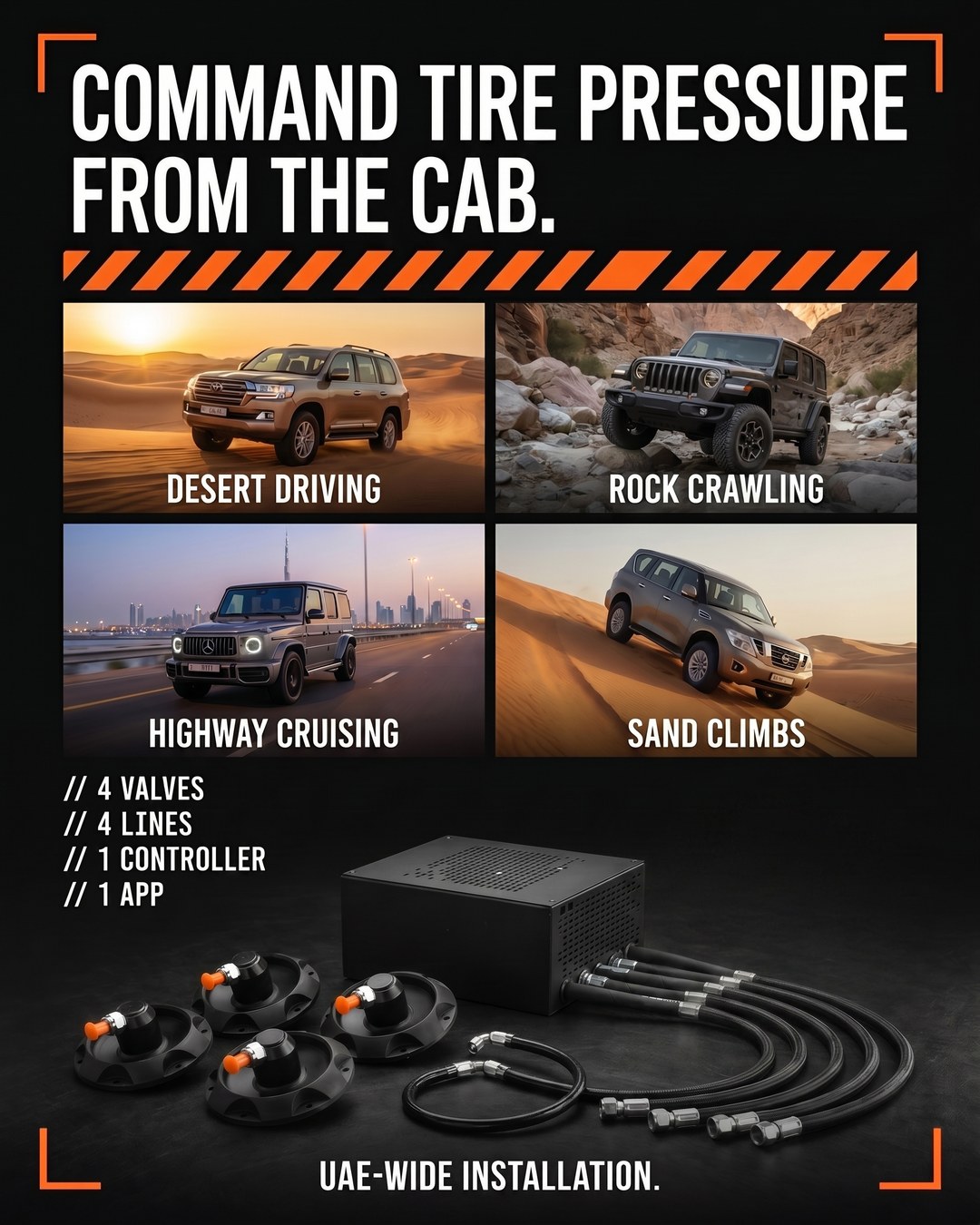
PSI by terrain (UAE specific).
Soft sand — Liwa, Empty Quarter, Moreeb Dune
Target: 10–15 PSI.
Liwa's grains are some of the finest in the world. Pure quartz, no clay, no mineral binding — the dunes "breathe" under your tires. You need maximum float to stay on top.
Light vehicles like a Wrangler can run as low as 8 PSI safely. Mid-weight Land Cruisers and G-Wagons sit in the 11–14 range. Heavier rigs (loaded Patrols, Tremors) live at 13–16.
Speed matters here too. Fast Liwa crosses and Moreeb hill-climb runs need a couple of PSI more than slow technical dune work — tire integrity over maximum float when you're at 80 km/h on sand.
Mixed dune / hardpack — Big Red, Fossil Rock, Sweihat
Target: 15–18 PSI.
Firmer than Liwa. The base of Big Red is soft, the crest is packed — you compromise around 16 PSI for most vehicles and let the tire handle both.
Fossil Rock is similar but with more exposed rock outcrops. The lower limit here is set by pinch-flat risk against rock, not float. Stay at 16–18 to keep the sidewall stiff enough to absorb impacts.
Beach driving — Saadiyat, Al Aqah, west coast inlets
Target: 12–18 PSI.
Beach sand varies wildly — the surface looks compact but goes soft 50 m in. Default to 15 PSI as a starting point, lower if you sink, higher if you're cruising on packed wet sand.
Sabkha / salt flats / dirt road — Hatta wadi run, Wadi Showka access
Target: 18–22 PSI.
Mostly compact, sometimes with a surface crust over softer underneath. Lower PSI here just adds unnecessary sidewall stress.
Exception: when sabkha is wet (after rare UAE rain) and you sink through the crust, drop to 14–16 to widen your contact patch.
Rock crawl — Mleiha, Showka, Wadi Showka boulder sections
Target: 14–18 PSI.
Tire flex around rock helps grip. But pinch flats become the dominant risk below 12 PSI on rocks with sharp edges. Most UAE rock crawl is short — a few hundred meters — so heat buildup isn't an issue.
Highway / tarmac return drive
Target: 32–38 PSI (check your door jamb for factory spec).
This is the one that kills more tires than anything else in UAE off-roading. Driving 80 km back to Dubai at 12 PSI with heat-soaked tires is a structural blowout waiting to happen. Re-inflate before you hit tarmac — every trip, no exceptions.
How to deflate manually.
The traditional routine. Budget 20–30 minutes in 45°C heat:
- Park on level ground at the edge of the dune line. Engage parking brake.
- Identify your target PSI from the table above for your terrain.
- Deflate each tire one by one. Unscrew valve cap, attach deflator (Staun preset or ARB E-Z deflator with gauge), let air out until target PSI is reached.
- Cross-check with your TPMS readout in the cab — cheap deflators sometimes lie by 1–2 PSI.
- Verify all four tires match within 1 PSI of each other. Imbalanced pressure causes uneven flotation.
Then on the way home, reverse the process with a 12V compressor — another 5–7 minutes per tire. Total tire-time per trip: 30–45 minutes of kneeling on hot sand, sweat through your shirt.
Common mistakes UAE drivers make.
- Trusting the deflator gauge over the TPMS. Cheap deflators read 1–3 PSI off. Always cross-check with your dash readout or a quality handheld gauge.
- Going too low for the conditions. Sub-8 PSI on a long fast Liwa run is a tire walking off the bead waiting to happen. Don't chase the lowest possible number.
- Forgetting to re-inflate before tarmac. A 50 km drive home at 12 PSI heats your tires to structural failure.
- Same PSI across a mixed convoy. A loaded Super Duty at 12 PSI behaves nothing like an empty Wrangler at 12 PSI. Mass matters — each vehicle gets its own number.
- Deflating from random apps or web tables. A lot of online guides are copy-pasted from US/Australian sources. UAE sand is finer and hotter — slightly lower than continental US numbers, slightly higher than Australian outback numbers.
The hands-free alternative.
Manual deflation works. It's also 25 minutes of kneeling in 45°C heat per trip — and the same again in reverse on the way home. UAE summers turn this into a real pain point, especially for drivers who run multiple desert trips per month.
A Central Tire Inflation System (CTIS) is permanently installed in your 4×4. It replaces your factory valve cores with system-compatible valves, routes pneumatic hose along the underbody to each wheel (with bulkhead fittings at each fender), mounts a control unit in the cab, and pairs with an app on your phone.
You set your terrain preset once. After that, deflation is two taps. The system handles all four tires in parallel while you keep driving — no need to stop at the edge of the dunes. Re-inflation on the way home is the same: tap, keep moving, pressure rises in the background until it hits highway PSI.
TireCommand is the UAE-installed version: 11,999 AED flat, every vehicle, 8–12 hour install in our Dubai bay, 2-year warranty on parts and labour. We install across the UAE — every emirate, every city.
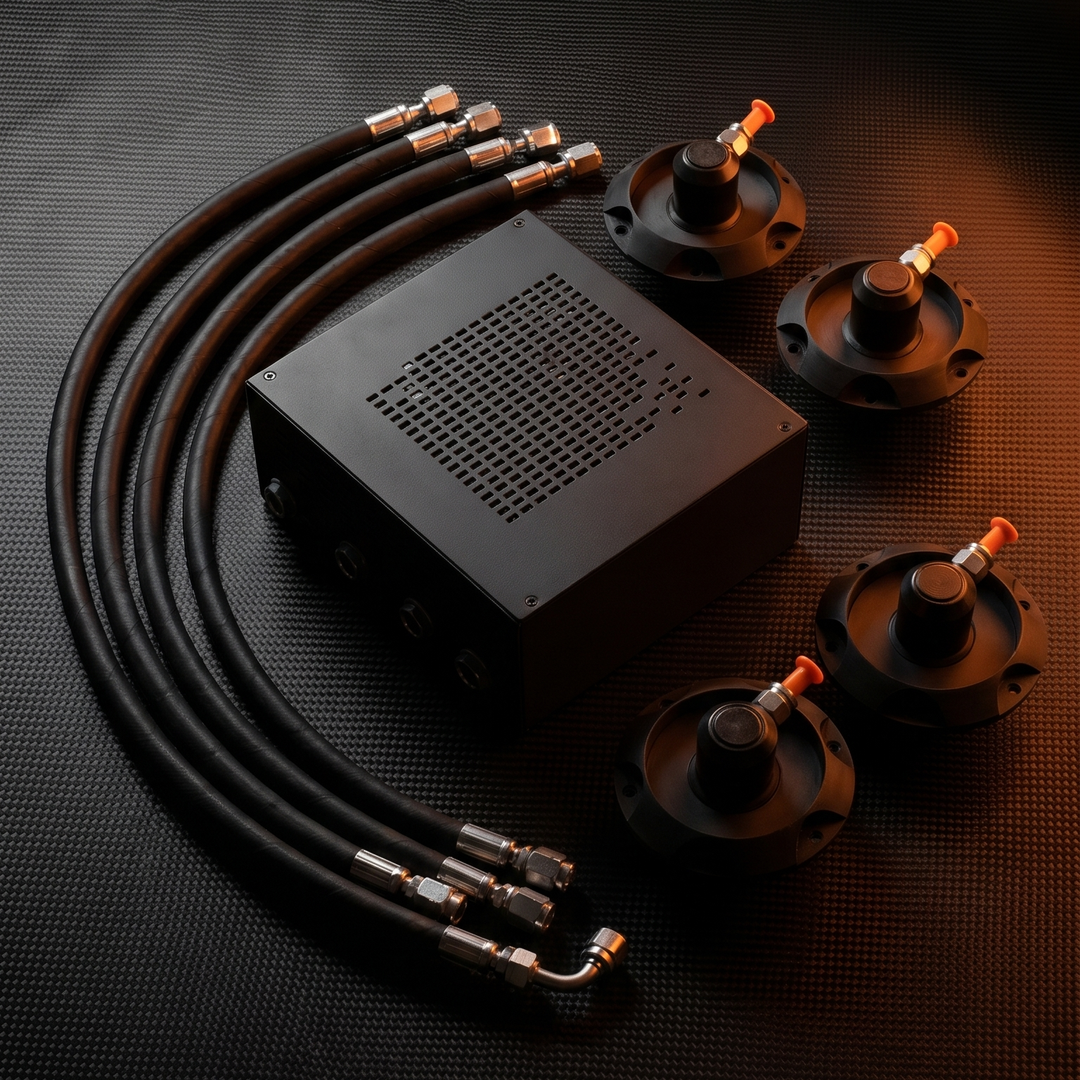
Stop kneeling. Start driving.
Two taps from the app. All four tires adjust hands-free. You stay in the cab with AC on. Same kit on every truck — LC, Patrol, Wrangler, G, Defender, Tremor, Super Duty.
DM 'DEMO' on Instagram →Frequently asked questions.
What PSI should I run in Liwa?
10–15 PSI depending on vehicle weight. Wrangler at 8–12, Land Cruiser at 12–15, Patrol Y62 at 11–13. Liwa's grains are some of the finest in the world and require maximum float. For high-speed Moreeb runs, stay at the upper end of the range for tire integrity.
How low is too low?
Below 8 PSI on most stock 4×4s risks de-beading the tire from the rim during a sharp turn or recovery jerk. Wranglers with beadlock rims can run lower safely. Most drivers should stay at 10 PSI minimum.
Do I need to deflate for Big Red?
Yes. Big Red has soft sand at the base and packed crest at the top — compromise around 16 PSI for most vehicles. Driving at highway pressure (32+ PSI) will leave you stuck on the third dune.
What about Fossil Rock — same PSI as Big Red?
Similar range but slightly higher (16–18 PSI) to avoid pinch flats against rock outcrops. Fossil Rock has more exposed rock than Big Red, so tire structure matters more than maximum float.
Can I leave for the highway at sand PSI?
No. A 50 km drive back to Dubai at 12 PSI heats your tires to structural failure — heat-induced blowouts are the most common preventable tire fatality in UAE off-roading. Always re-inflate to highway spec before tarmac.
My TPMS warning light is on after deflating — is something wrong?
No. The TPMS is just reporting that pressure is below factory spec. That's the point of deflation. The light goes off once you re-inflate to highway PSI.
Should I run different PSI front vs rear?
Generally no for unloaded vehicles. If you're carrying significant rear load (camping gear, fuel cans, recovery kit), 1–2 PSI extra on the rear axle helps maintain balanced contact patches.