What is CTIS?
Central Tire Inflation System, Explained.
The problem CTIS solves.
Every UAE off-road weekend starts and ends the same way. Park at the edge of the dunes. Get out in 45°C heat. Kneel by each tire. Unscrew the valve cap. Press down on a deflator until the gauge reads 12 PSI. Move to the next tire. Repeat. 25 minutes later, you finally drive in.
Then on the way home, do the same thing in reverse with a 12V compressor. Another 30 minutes of waiting next to the truck, this time at sunset with everyone wanting to get back to Dubai.
That hour of your weekend spent kneeling next to tires is what CTIS removes. Permanently. Every trip.
What CTIS is.
CTIS stands for Central Tire Inflation System. The name describes it precisely: a single control point ("central") manages all four tire pressures simultaneously. The driver never touches the tires manually.
Mechanically, CTIS is a permanent installation in your 4×4. It's not a tool you carry — it's part of the vehicle. Once installed, it's there for the life of the truck.
The kit — what you actually get.
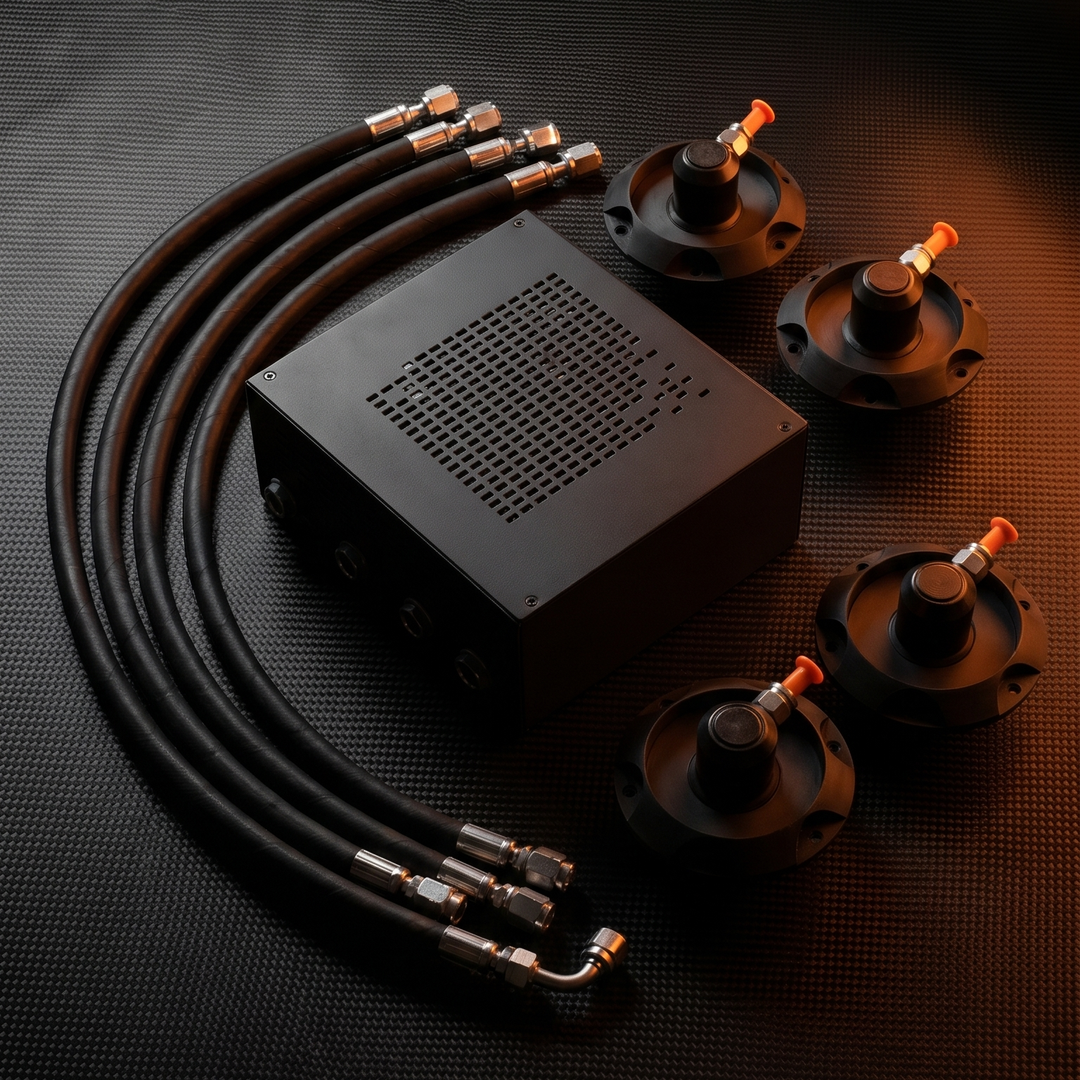
Four parts. That's it.
1. Four replacement valve cores
These swap directly into your existing wheel valve stems — same standard threading as a stock valve core, just with an air-line connection point added. No drilling, no machining, no rim modification. The replacement is a service-grade swap.
2. Four polyurethane air lines
Pneumatic hose routed along the underbody from each wheel up to the control unit, with chrome bulkhead fittings at each fender. Properly secured routing means: no dangling hoses, minimal sand-blasting exposure, no snags on dune ridges, protected from UV breakdown.
3. One control unit
Mounted in the cab — typically behind the rear seat or in the cargo area, depending on vehicle. The control unit contains the manifold, the small onboard pump for inflation, the wiring to your 12V system, and the Bluetooth/Wi-Fi module that pairs with your phone.
4. One mobile app
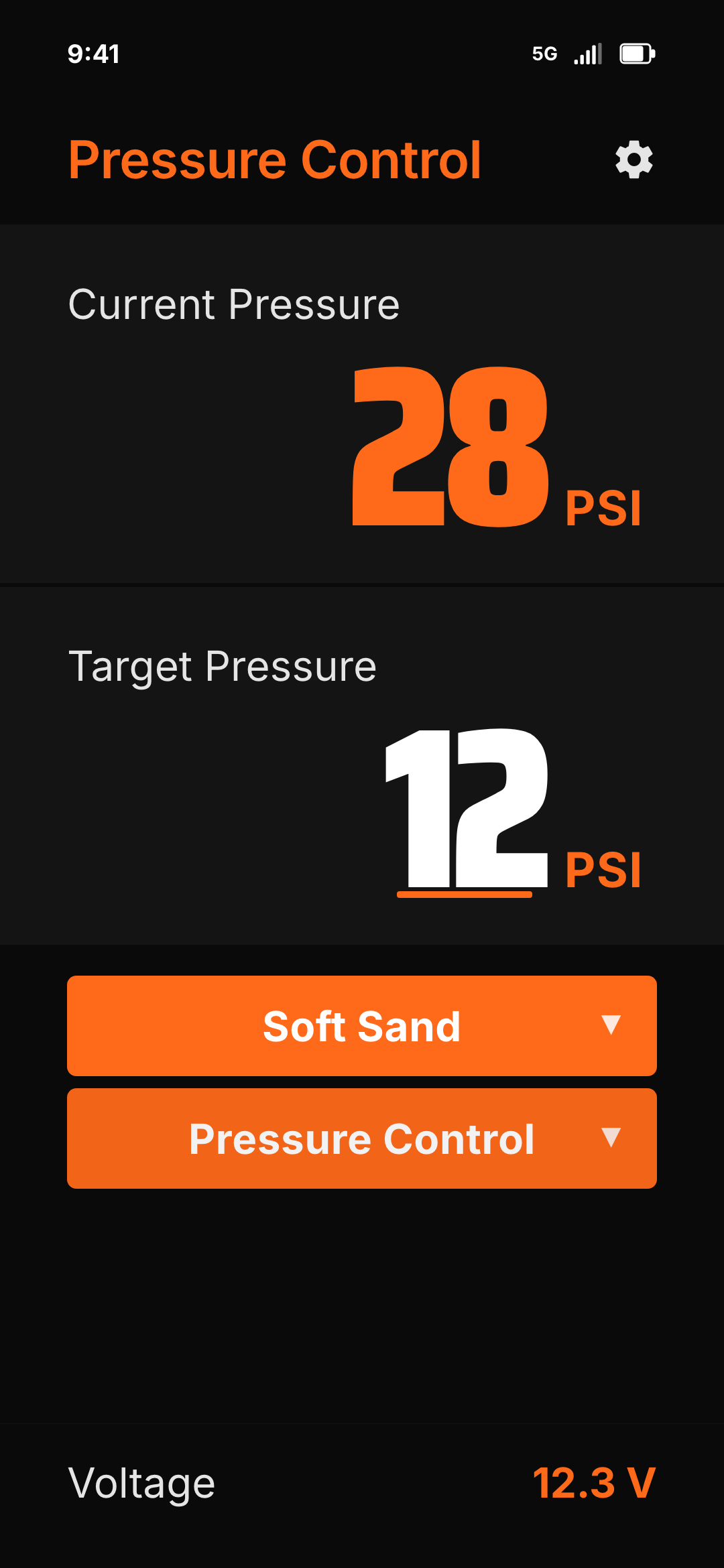
Pairs with the control unit. Pre-loaded terrain presets (soft sand, beach, rock crawl, highway). Live PSI readout for each tire. Set a target, tap to execute, system handles the rest.
How it works.
- You drive to the edge of the dunes. Park, stay in the cab.
- Open the app. Select "Soft Sand" preset (pre-loaded with your terrain PSI from the manufacturer or your own setting).
- Tap once to start deflation.
- The system opens the valves and bleeds air out of all four tires simultaneously until target PSI is reached.
- You see live PSI for each tire on your phone. AC stays on. You don't move.
- Drive in.
On the way home, same thing in reverse — except the onboard compressor adds air this time instead of bleeding it out. Tap and keep driving; pressure rises to highway PSI in the background while you move.
Where CTIS came from.
The technology is old. CTIS was developed by the US military in the 1980s for Humvees (HMMWV) and MAN trucks operating in mixed terrain — beach landings, then highway transit, then desert. Manual tire deflation was operationally too slow.
Civilian aftermarket systems emerged in the early 2000s, first in Australia (where dune driving is part of the off-road culture), then in the US overland scene, then in South America for jungle/sand expeditions. UAE adoption has been slower because the workshop expertise simply wasn't available locally — most early UAE CTIS users imported systems and had them installed abroad.
That's changing now. Locally installed CTIS in the UAE is a recent capability and it's why most serious 4×4 owners haven't seen one yet.
Why CTIS matters more in UAE.
The case for CTIS depends on two variables: climate and trip frequency.
UAE climate is brutal for manual deflation. 45–50°C summer afternoons, direct sun, hot sand. Kneeling next to your tire for 25 minutes is physically punishing — you arrive at the dunes already tired, and you arrive home already exhausted.
UAE trip frequency is high. Active off-roaders run 2–4 desert weekends per month. Multiply 30 minutes of manual deflation × 4 trips × 12 months = 24 hours a year of kneeling next to tires. That's three full working days.
Continental US or European overlanders run maybe 5–10 desert trips a year, often in cooler climates. The math on manual deflation works for them. In the UAE, the math is different.
What CTIS doesn't do.
A few common misconceptions:
- It isn't instant. Deflation and inflation each take a few minutes — the time depends on tire volume and the difference between starting and target PSI. The win isn't raw speed; it's that you stay in the cab while it runs.
- It doesn't run forever. The onboard compressor draws current from your 12V system. For typical UAE use (a few cycles per trip), this is irrelevant — your alternator keeps up easily. Heavy convoy use with constant cycling might require an upgraded compressor.
- It doesn't replace tires. You still buy AT or MT tires for off-road use. CTIS controls pressure; it doesn't change which tire you're running.
- It isn't for everyone. If you drive in the desert twice a year, manual deflation is fine. CTIS makes sense for owners who do it consistently and want the friction removed.
Who installs CTIS in the UAE.
UAE-installed CTIS is now available from a small number of workshops. The key things to look for:
- Workshop install, not driveway. Hose routing requires lifting the vehicle and working from underneath. Driveway installs cut corners.
- Pneumatic hose secured along the underbody with proper bulkhead fittings — not loose zip-ties or external runs. Bad routing fails fast in UAE sand.
- Direct valve core swap — no drilling of wheels. A correctly designed CTIS uses serviceable valve cores, not modified rims.
- Warranty on parts and labour — a system without labour warranty means you pay every time it needs servicing. Insist on 2 years minimum on both.
- Flat pricing — install cost shouldn't depend on your specific vehicle. Same kit, same install, same price.
TireCommand is the UAE-installed version that meets all five criteria. 11,999 AED flat install, every vehicle. Includes parts, full labour, and 2-year warranty on both. Workshop bay base in Dubai with install across all 7 emirates.
Free walkthrough — DM us on Instagram.
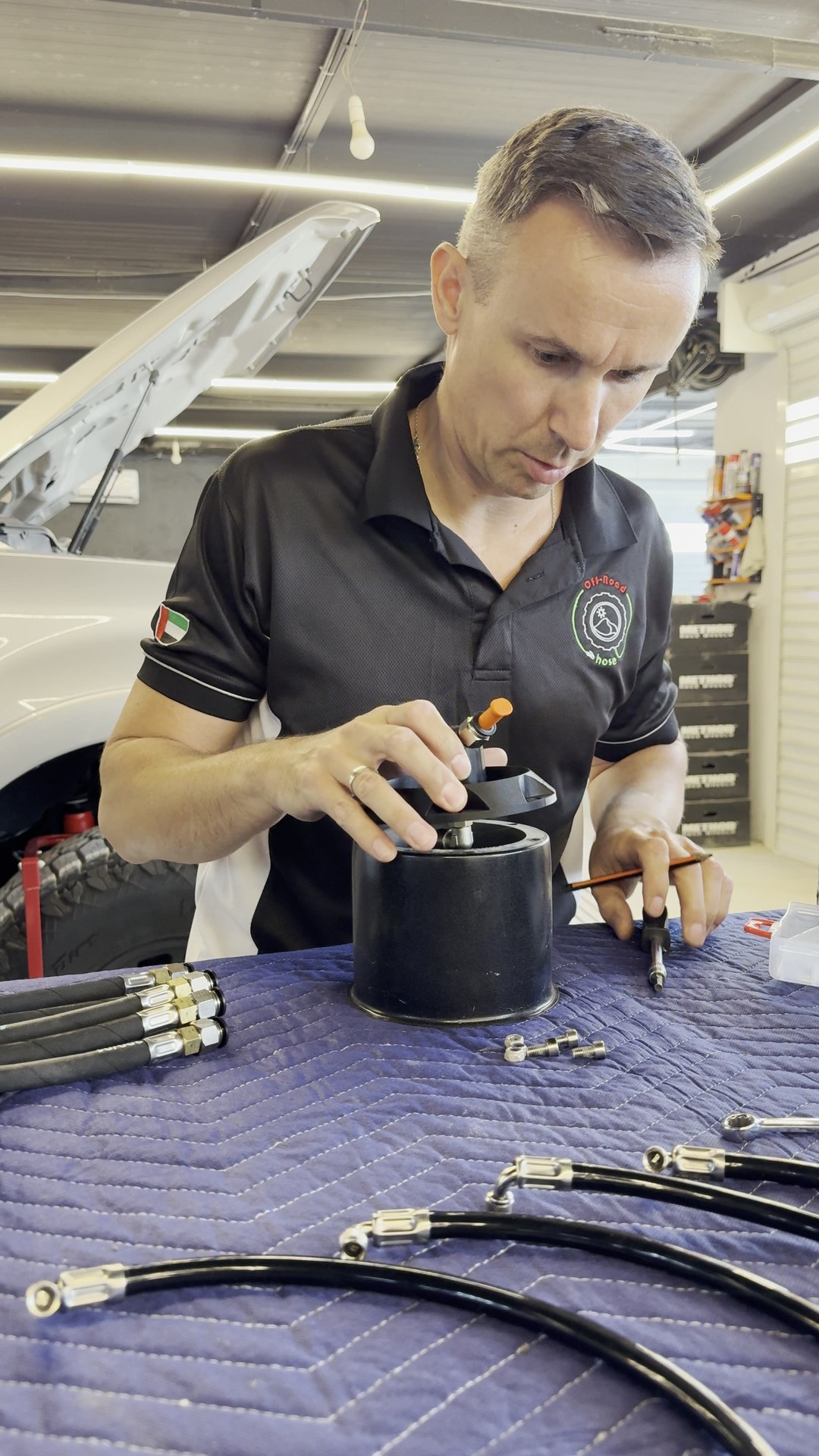
We'll send you the full install breakdown for your specific vehicle: where the controller mounts, how the hose routes, what the app looks like in action.
DM 'DEMO' on Instagram →Frequently asked questions.
What does CTIS stand for?
Central Tire Inflation System. A permanently installed system on a vehicle that lets the driver inflate or deflate all four tires from a single control point — typically a button, switch, or app — without leaving the cab.
How does CTIS actually work?
Four components: (1) replacement valve cores on each wheel, (2) pneumatic hose secured along the underbody with bulkhead fittings at each fender, (3) a control unit mounted inside the cab, and (4) an app on your phone. You set a target PSI in the app; the system either bleeds air out or pumps it in via the onboard compressor until the target is reached on all four tires.
Is CTIS only for military vehicles?
No. CTIS was developed by the US military for Humvees and MAN trucks in the 1980s, but civilian aftermarket systems have been widely available since the early 2000s.
Does CTIS void my vehicle warranty?
A correctly installed CTIS does not modify structural components, ECU, or body panels. It replaces standard serviceable valve cores and routes hose along the underbody with bulkhead fittings. Your dealer warranty stays intact. Verify with your installer that they don't drill structural members.
How long does a CTIS install take?
For a 4×4 workshop install, typically 8–12 hours. The vehicle is in the bay all day — wheels off, hoses routed, controller wired, app paired. Most workshops return the vehicle the same evening.
Does CTIS include an onboard air compressor?
Most CTIS installs (including TireCommand UAE) do not include the compressor. They integrate with the 12V onboard compressor already installed in the vehicle. Inflation requires a compressor to push air in; deflation just opens the valves. Most serious 4×4 owners already run an onboard compressor for off-road use. If you don't have one, install it before booking a CTIS install.
Can I install CTIS myself?
Technically possible with advanced pneumatic and mechanical skills, but inadvisable for most owners. Improper routing risks underbody abrasion, hose failure under heat, and leak points. Most UAE owners get it installed by a specialist.
Is CTIS worth it in the UAE specifically?
The argument is strongest in the UAE because of extreme heat (45–50°C summer days make manual deflation punishing) and trip frequency (active owners run 2–4 dune trips per month). For occasional desert drivers it's a luxury; for regular dune-bashers it removes the single biggest friction of the hobby.